
What Does “Assembled in America” Actually Mean? An Honest Answer From an Indiana Watch Company
Written by Dr. Adam Fleddermann, Founder & CEO of Fleddermann von Rieste, who designs every watch and oversees manufacturing and operations.
Short answer first, because you deserve it before the throat-clearing: it means the watch was put together here, by hand, by a person. It does not mean every part inside it was made here. If you’ve been shopping American assembled watches and wondering whether that phrase is doing honest work or marketing work, the truthful answer is that it depends entirely on the company saying it.
So let me start with the thing most brands bury in a FAQ. We do not manufacture our own movements. Almost no American made watch brand at our prices does. Anyone who tells you different is either doing something genuinely rare and charging what that costs, or they’re being loose with language and hoping you don’t ask.
The rest of this post is me showing my work, including the parts that don’t flatter us.

Made in USA vs assembled in USA: there is an actual legal standard
This isn’t a vibes question. The Federal Trade Commission regulates country-of-origin claims, and the bar for saying “Made in USA” without qualification is high. The product has to be “all or virtually all” made here, meaning final assembly happens in the United States, all significant processing happens here, and essentially all components are sourced here. The FTC codified that standard in its Made in USA Labeling Rule in 2021, and companies that get it wrong can face civil penalties.
Here’s the part that made me laugh when I first read it. The FTC’s own guidance uses a watch company as its example of getting this wrong. The scenario they describe is a company building watches at a plant in Nevada, using mostly American parts and labor, with inexpensive Swiss movements inside. The movements are a small slice of the total cost. The FTC’s position is that an unqualified Made in USA claim would still be deceptive, because without the movement the watch can’t tell time. The component is too essential to wave off, no matter how little it costs.
I think that’s exactly right, and it’s the reason I don’t use the phrase.
“Assembled in USA” is a different claim with a different bar. The FTC permits it without qualification when the principal assembly happens here and that assembly is substantial, and when the last substantial transformation of the product occurred here. What doesn’t qualify is what the guidance calls a screwdriver operation, where finished components get snapped together at the tail end of the process. That distinction is the whole ballgame, and it’s what separates a hand-built American watch from a box that got opened in Ohio.
So when you compare American watches from two different brands and both say something about American origin, the words are not interchangeable. One is a claim about where every part came from. The other is a claim about where the work happened. We make the second claim.
What "assembled in America" means at this Indiana watch company
Here’s what actually happens.
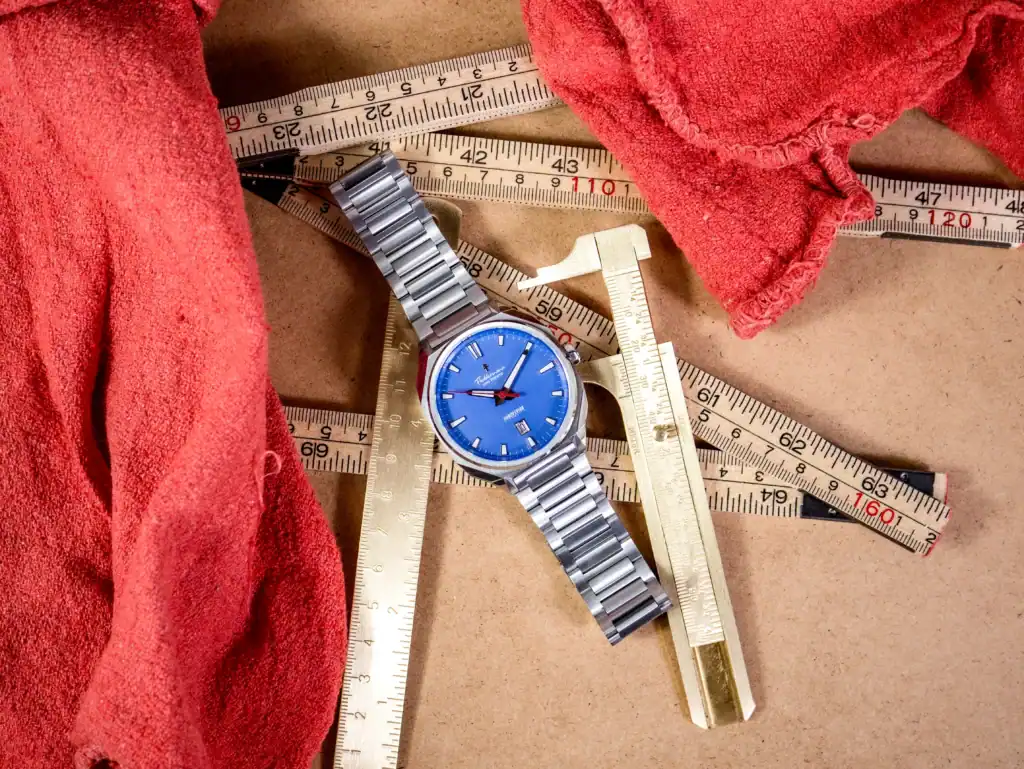
Components arrive. A watchmaker sits down at a bench in Indiana and builds the watch. He fits the movement to the case, sets the hands, cases it up, regulates it, tests it, and puts his judgment on whether it leaves. That’s Adam Parrish, an AWCI-certified watchmaker in Kokomo, working with his apprentices Jason and Tanner. When your watch needs service in fifteen years, it goes back to the same bench.
That is the substantial assembly the FTC is describing. It is not a screwdriver operation, and it’s not a marketing department’s idea of one. We are a family owned watch company and an independent American watchmaker, which mostly means there is nobody between you and the person who made the decisions about your watch. That is the whole of what this American watch company is.
What it is not: a claim that the movement, the sapphire crystal, or the 316L steel originated in Indiana. They didn’t. We use Japanese and Swiss movements. Depending on the model, ours is an American watch with Swiss movements or with Japanese movements, and the specific movement in any given watch is published on that model’s product page. That’s where a spec belongs, and putting it in writing beats making you ask.
Hand assembled watches: the part nobody puts in an ad

Assembly gets all the language. Regulation is where the actual difference lives, and almost nobody markets it because it’s hard to make sound exciting.
A mechanical movement doesn’t leave its manufacturer running perfectly. It leaves running within a range. Regulating means adjusting the balance so the watch keeps time to spec, then checking it in multiple positions, because a watch behaves differently lying flat on a nightstand than it does hanging crown-down on your wrist overnight. A watchmaker dials that in, tests it, and dials it again.
Two watches with the same movement, same case, same everything, can keep noticeably different time depending on whether a person did that work or skipped it. It takes real time per watch, which is exactly why it’s the first thing cut when a brand is racing to a price.
That’s the honest content of the phrase hand assembled watches, at least as we use it. Not that a robot didn’t touch it. That a trained person made decisions about your specific watch. It’s also the part of watches assembled in USA that’s worth paying for, and the part that’s easiest to skip while still using the words.
Precision as an inheritance isn’t a line I reached for, either. My dad co-founded a tool and die shop in Batesville in the 1970s, and I worked in it through school. Tool and die is a trade where close is wrong. That standard walked over to the watch bench with us.
What we do not claim
We say assembled and hand-regulated in Indiana. We don’t say Made in USA, because we’d be lying, and because the FTC would be right to say so.
We also don’t dress up the spec sheet. Sapphire crystal, 316L stainless steel, 10 ATM, two-year full warranty, and a price range of $500 to $1,800, with every model but one landing under $1,000. Those are ordinary materials chosen because they last, not because they photograph well. A sapphire crystal watch resists the scratches that fog cheaper glass, and 10 ATM means rain or a swim is a non-event. None of that is exotic and I won’t pretend it is.
American watch brands that go further than we do
If full domestic manufacture is what you’re after, you should know who’s actually doing it, even though it means sending you elsewhere. Anyone assembling a shortlist of the best American watch brands should have these on it.
RGM in Pennsylvania manufactures movements in the United States. That is rare, difficult, and expensive, and they’ve earned every bit of the reputation it buys them. Weiss in Nashville has pushed hard on American-made components. Vortic in Colorado builds wristwatches around restored antique American pocket watch movements, which is a genuinely different answer to this whole question and a good one. Shinola assembles at scale in Detroit.
Every one of those is worth someone’s time. A couple of them are doing things we don’t. If your priority is USA made watches with the deepest domestic content rather than the best affordable American made watches, start with RGM and Vortic and don’t let me talk you out of it.
What to ask any American made watch brand
Take these to anybody, including me. They work on any of the USA watch brands selling American wrist watches at any price.
Where is the movement made, and who makes it? A brand that gets cagey here is telling you something.
Who assembles the watch, and where do they sit? A name and a town is a good sign. A region is not.
Is anyone regulating the movement by hand, or does it ship as it arrived?
Where does it go for service in ten years, and does that place still exist if the brand doesn’t?
Does the company say “Made in USA” or “Assembled in USA,” and can they explain the difference when you ask?
That last one sorts people fast. The phrase is only as good as the willingness to explain it.
Common questions about American made and assembled watches
What is the difference between “Made in USA” and “Assembled in USA”?
“Made in USA” is an origin claim about the whole product: under the FTC standard it must be all or virtually all domestic in parts and processing. “Assembled in USA” is a claim about where the work happened, permitted when principal assembly is substantial and occurs here. A watch built abroad and unboxed here qualifies as neither. A watch assembled and regulated at an American bench from imported components is the second, not the first.
Are any watches actually made in the USA?
A small number, yes, and they cost what that takes. RGM manufactures movements domestically and Vortic builds around restored American movements. Most brands using American language are describing assembly rather than manufacture, which is legitimate when they say so plainly and misleading when they don’t.
Do American watch brands use Swiss or Japanese movements?
Nearly all of them do, ours included. Domestic movement manufacture essentially disappeared from the United States in the twentieth century, and rebuilding that capacity is the expensive, rare thing a handful of companies are attempting now. A brand using Swiss or Japanese movements isn’t cutting a corner. A brand hiding which one it uses might be.
Is “assembled in USA” just marketing?
It depends entirely on what happens at the bench. Substantial assembly plus hand regulation by a trained watchmaker is real work that changes how the watch performs. Snapping together finished modules is what the FTC calls a screwdriver operation and doesn’t qualify for the claim at all. Same phrase, opposite realities, which is why the follow-up question matters more than the label.
How can I verify where a watch is assembled?
Ask for a name and a town, not a region. Ask whether the movement is regulated by hand and by whom. Ask where the watch goes for service in ten years. Check whether the movement origin is published on the product page or has to be pried loose. None of that requires expertise, and all of it is hard to fake.
Where to start
We may not be your grandfather’s watch. But with time, we hope to be your grandson’s, and that’s not a thing you get to be by shading the truth about where your parts come from.
If you want to see what the bench in Indiana turns out, take a look at the Hanoverian, our 41mm everyday automatic. Or skip all that and email me at adam@fvrwatch.com with the hardest version of any question above. I’d rather answer it than have you wonder.
And if the reason you’re reading this is that you’re trying to buy something built to hand down, I wrote a separate post on what makes a watch an heirloom, which is a different question from where it was put together.

Dr. Adam Fleddermann, Founder & CEO
Dr. Adam Fleddermann founded Fleddermann von Rieste after growing up watching his father care for a watch passed down through generations of the family. He designs every watch and oversees the brand’s global supply chain, operations, and manufacturing, working alongside an AWCI-certified watchmaker and his team who lead the hand-assembly of every timepiece in Indiana.
