The famous racing watches behind motorsport history, from the Carrera to the Daytona, and the Indiana-assembled Zeitfahren racing chronograph.
October 29, 2026
Written by Dr. Adam Fleddermann, Founder & CEO of Fleddermann von Rieste, who designs every watch and oversees manufacturing and operations.
Here in Indiana, racing isn’t a hobby. It’s practically a season on the calendar, right between planting and harvest. So it’s no surprise that some of our favorite watch stories come from the track. Many of the most famous racing watches were built for a practical reason: before timing screens and transponders, a driver, a crew chief, or a guy with a clipboard needed to know how fast a lap really was. Here’s a look at the motorsport watches that became legends, why racing and chronographs grew up together, and where our own little racing chronograph fits in.
As always with posts like this, I’m just describing watches I admire. None of these brands or drivers have any connection to us, and nobody’s endorsing anything.
Why Racing and Watches Go Together
A chronograph is a watch with a stopwatch built in. Press a button, time a lap, press it again. Before electronic timing took over, that was how a lot of racing got measured, from the pits to the grandstands. Add a tachymeter, the speed scale printed around the dial or bezel, and you could work out average speed over a known distance without any math.
So the racing watch was born as a tool. The style came later, when the people wearing them turned out to be some of the coolest folks on the planet.
Famous Racing Watches Worth Knowing
The Heuer Carrera
Introduced in 1963, the Carrera took its name from the Carrera Panamericana, a brutal road race across Mexico in the early 1950s. Jack Heuer wanted a chronograph that was clean and easy to read at a glance, with no clutter to slow a driver down. That clean, legible approach became a big part of the modern racing chronograph look.
The Heuer Autavia
The Autavia got its name by mashing together two words, automobile and aviation, which tells you exactly who it was for. Heuer made dashboard timers under that name before putting it on the wrist in the early 1960s. It was a favorite in racing circles for years.
The Heuer Monaco
Square cases weren’t normal for chronographs when the Monaco arrived in 1969. Then Steve McQueen wore one in the 1971 film Le Mans, and it went from oddball to icon almost overnight. It’s proof that a racing watch can become famous as much for the attitude around it as for the tool inside it.
The Rolex Daytona
Rolex introduced its Cosmograph chronograph in the early 1960s, and it soon picked up the Daytona name, after the racing at Daytona Beach, Florida, where drivers once chased speed records on the sand. Rolex’s ties to Daytona run deep, and its name has been on the famous 24-hour race there for decades. The Daytona is probably the most talked-about racing watch in the world today, helped along by Paul Newman, who wore his while racing and made one particular Daytona legendary.
The Omega Speedmaster
Most folks know the Speedmaster as the Moonwatch, but it started out in 1957 as a sports and racing chronograph. It helped popularize putting the tachymeter scale on the bezel instead of the dial, which gave the dial more breathing room. A racing watch that ended up on the moon is a pretty good career arc.

What Makes a Great Motorsport Watch
Line those icons up and you’ll notice they share a few things, whatever they cost:
- Legibility first. At speed, you don’t have time to squint. High-contrast dials and clear subdials matter.
- Useful tools. A chronograph and a tachymeter aren’t decoration on a racing watch. They’re the point.
- Cars vibrate and cockpits get hot. A racing watch has to take a beating.
- A little personality. Racing liveries, bold colors, and a bit of swagger. Motorsport watches have never been shy.
You don’t need to spend what a Daytona costs to get those things. Plenty of brands, from Seiko to Tissot to Hamilton, make good racing-inspired chronographs at friendlier prices. It’s a category with a lot of good options.
Racing Runs Deep in Indiana
You can’t talk racing around here without the memorial day in May, which has been running in Speedway, IN since 1911. It’s the kind of place where tradition matters. Winners still drink milk in Victory Lane, a habit that goes back to the 1930s. We even built our spring season, May Days, around that milk-in-Victory-Lane tradition.
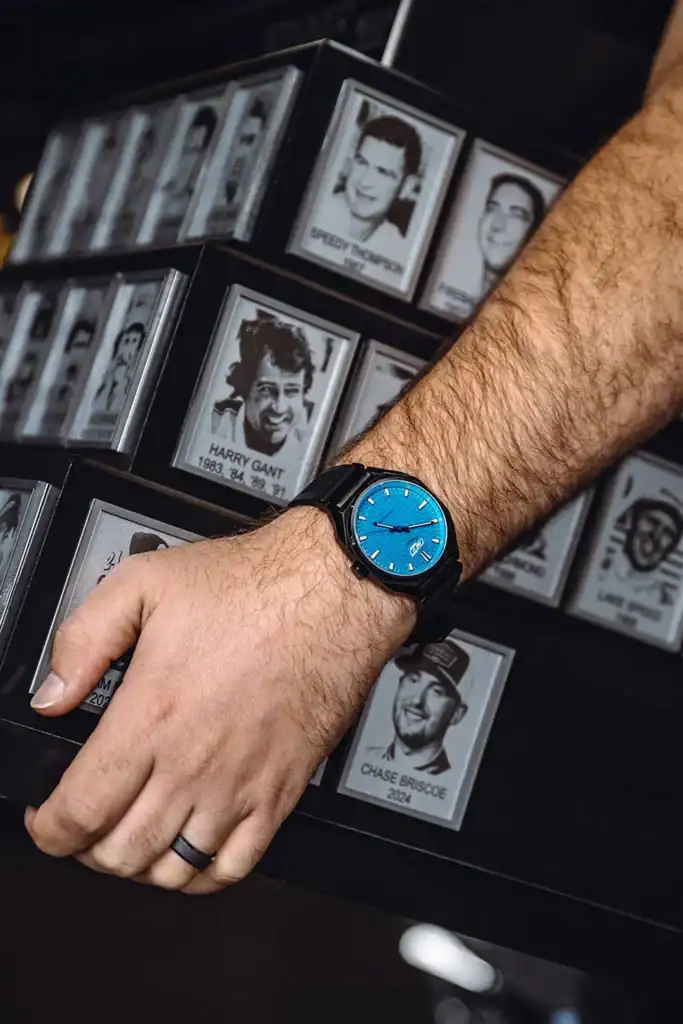
Racing is also part of our own story. We partnered with Chase Briscoe, the NASCAR driver from Mitchell, Indiana, on a limited edition of our Hanoverian. It’s been a lot of fun seeing a Hoosier kid who made it to the top level of the sport wearing a watch that was hand assembled a couple of hours from where he grew up.
The Zeitfahren, Our Racing Chronograph
“Zeitfahren” is German for “time trial,” which felt like the right name for a racing watch from a German American family. It’s our American chronograph watch, and it borrows from the same racing playbook as the icons above, just at a very different price.
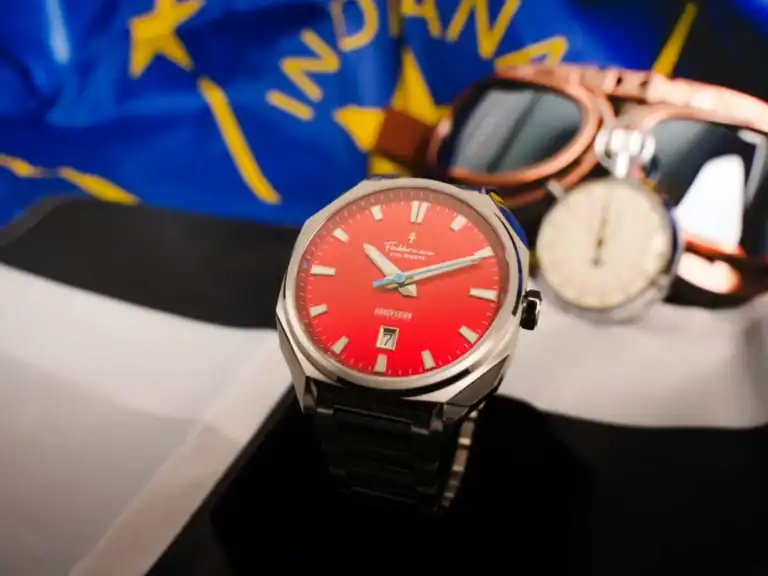
Here’s what’s true about it. It has a 40mm polished 316 stainless steel case, a tachymeter bezel, and an asphalt-textured dial, a little nod to the track surface. The hands and markers use Swiss Super-LumiNova, and a sapphire crystal protects the dial. It wears on a leather rally strap and has a date window at six. Its dial colors are inspired by classic racing liveries, with names like Trackside White, Apex Blue, Rally Blue, Endurance Blue, Frosted Beryl, and Overdrive Orange.
I’ll be straight with you about the movement, too. The Zeitfahren uses a Swiss Ronda quartz chronograph movement, not a mechanical one. That makes it accurate, reliable, and easy to live with, and it keeps the price attainable. If you have your heart set on a mechanical racing chronograph, the Swiss brands above make fine ones, and I’d tell you so. But if you want a sharp, dependable racing watch with a real story behind it, the Zeitfahren is worth a look.
Like every watch we make, it’s hand assembled in Kokomo, Indiana, by an AWCI-certified watchmaker, rated to 10 ATM, and backed by a two-year full warranty, with service at the same bench that built it.
The Real Legacy of Racing Watches
The most famous racing watches didn’t become legends because of their price tags. They became legends because people wore them while doing something they loved, then passed them along with the stories attached. That’s the part anybody can have. Wear your watch to the track, time a few laps, and someday hand it down with the stories.
That’s what we mean by attainable legacy watches, heirlooms from the first time on your wrist. We may not be your grandfather’s watch, but with time, we hope to be your grandson’s.
If racing’s in your blood, take a look at the Zeitfahren or our Chase Briscoe Hanoverian. And if you want to talk racing, watches, or both, just email me at adam@fvrwatch.com. I’m always up for either.
.

Dr. Adam Fleddermann, Founder & CEO
Dr. Adam Fleddermann founded Fleddermann von Rieste after growing up watching his father care for a watch passed down through generations of the family. He designs every watch and oversees the brand’s global supply chain, operations, and manufacturing, working alongside an AWCI-certified watchmaker and his team who lead the hand-assembly of every timepiece in Indiana.
