
Famous Watches on the Moon: The Story of Watches in Space
Written by Dr. Adam Fleddermann, Founder & CEO of Fleddermann von Rieste, who designs every watch and oversees manufacturing and operations.
Ask most people to name a famous watch and you’ll get the moon one. Fair enough. But the story of watches in space is a good deal stranger and better than the one line everybody knows, and almost none of it happened the way the marketing suggests.
Let me start with the part that surprises people. The first watch in space wasn’t Swiss, wasn’t American, and wasn’t chosen for the job at all.

The first watch in space was standard issue
On April 12, 1961, Yuri Gagarin orbited the Earth once aboard Vostok 1, a flight of 108 minutes. On his wrist was a Sturmanskie, a navigator’s watch made by the First Moscow Watch Factory and handed out to Soviet air force pilots when they graduated flight school. Gagarin got his at Orenburg in 1957.
Nobody selected it for spaceflight. Nobody tested it for vacuum. It was simply the watch he’d been issued as a pilot, and he wore it the way you’d wear the watch you already own. There was no space watch program in 1961 because nobody had thought to want one yet.
I find that more impressive, not less. The first timepiece in orbit was a working man’s tool that happened to be on the wrist of a man doing something nobody had done.
Four years later, on March 18, 1965, Alexei Leonov left Voskhod 2 for the first spacewalk in history and spent about twelve minutes outside the craft. He wore a Strela chronograph, also from the First Moscow Watch Factory, running the caliber 3017 movement based on a Swiss Venus design and reworked by Soviet engineers. That watch was outside a spacecraft, in vacuum, during the single most dangerous quarter hour of the space race to that point.

NASA held a bake-off, and only one watch finished
The American approach was more bureaucratic and, honestly, more interesting.
In September 1964, NASA’s flight crew operations director put out an internal memo saying the Gemini and Apollo crews needed a durable, accurate chronograph. Because NASA is a government agency, that meant a formal request for proposals, and it meant off-the-shelf production watches rather than anything custom.
Several manufacturers submitted. The testing ran from late October 1964 into the following spring, and it was designed to break things: temperature extremes, vacuum, humidity, corrosion, shock, acceleration, vibration, and noise. Eleven tests in all, run by NASA engineer James Ragan.
One watch finished. The Omega Speedmaster completed the qualification and was declared flight-qualified for manned missions, with the test report completed March 1, 1965 and the formal acceptance following that June. The other entrants failed, several during the thermal vacuum phase.
Two things about that are worth sitting with. First, it was a regular production chronograph you could have bought in a store, not a purpose-built instrument. Second, it was a hand-wound mechanical watch, and it stayed that way for the entire program.
That wasn’t nostalgia. A self winding watch depends on a rotor swinging against gravity, and in weightlessness there isn’t much to swing against. A digital display has its own trouble with temperature and light angle during a spacewalk. A mainspring you crank yourself has neither problem. Every automatic watch on Earth is a marvel of convenience, and none of it helps you in orbit.
What actually happened on the moon
Here’s the detail that gets flattened in the retelling.
Neil Armstrong stepped onto the surface first, and he was not wearing his watch. The lunar module’s electronic timer had malfunctioned, so he left his Speedmaster inside the Eagle as a backup timing device in case the crew needed one. Buzz Aldrin, who came out about nineteen minutes later, wore his. That’s how a chronograph became the first watch on the moon: not because of a marketing decision, but because a clock broke and a commander made a sensible call about redundancy.
The moonwalk lasted 2 hours and 36 minutes.
A sad footnote. Aldrin’s watch was government property headed for the Smithsonian, and it disappeared in transit in the early 1970s. It has never been recovered. The most historically significant wristwatch of the twentieth century is, as far as anyone knows, in a drawer somewhere.
Fourteen seconds
The best watch story from the whole program isn’t about the landing at all.
When an oxygen tank ruptured aboard Apollo 13 in April 1970, the crew ended up in a powered-down spacecraft making course corrections by hand. One of those corrections required a burn of the lunar module’s descent engine timed to fourteen seconds, and the onboard timers weren’t available to do it.
Jack Swigert timed it on a Speedmaster while Jim Lovell held the craft’s orientation against the Earth’s horizon. The burn ran to within a tenth of a second of the target. A later correction, considerably longer, was timed the same way. The crew splashed down safely on April 17.
That October, NASA gave Omega its Silver Snoopy Award, the commendation the agency reserves for contributions to flight safety and mission success. Of roughly fifteen thousand recipients since 1968, it remains the only watch company to have received one.
I like this story because nothing about it is glamorous. A man in a freezing capsule watched a second hand sweep and counted. The watch didn’t do anything clever. It just kept running when it was the only thing left that could.
The American chronograph on the moon that nobody talks about
Here’s one for the American watch brand crowd, and it’s a genuinely great story.
American watch brands weren’t absent from the space program, they just lost the headline. Bulova, the New York company, wanted the NASA wrist contract and didn’t get it. Their Accutron timing units still flew aboard dozens of missions across the 1950s and 60s, doing quiet work inside equipment rather than on anybody’s wrist.
So in 1971, Bulova approached Apollo 15 commander Dave Scott a few months before launch and asked him to evaluate one of their chronographs in flight.
During the mission’s second excursion, the crystal popped off Scott’s NASA-issued Speedmaster. He noticed back in the cabin. For the third and final moonwalk, he swapped the Bulova onto the strap and wore it on the lunar surface for nearly five hours.
Because every NASA-issued watch was government property, Scott’s privately owned Bulova became the only watch worn on the moon that a private individual could ever own. He kept it in a bag for forty years. In 2015 it sold at auction for $1,625,000, a record for a timepiece used on the lunar surface.
An American chronograph watch walked on the moon as a backup, because something broke. That’s a very American way to get there, and worth remembering when people discuss American watches as though the category showed up last Tuesday.
What all these watches have in common
Look at the list. A Soviet pilot’s standard-issue watch. A production chronograph bought off a shelf and put through hell in a lab. A backup that got its shot because a crystal failed.
Not one of them was famous when it went. They were tools, chosen for being reliable and legible and mechanical, and every single one was wound by hand. They became legendary afterward, and only because of what the person wearing them was doing at the time.
That’s the whole lesson, and it applies a long way down from the moon. A watch doesn’t carry meaning on its own. It picks meaning up from a life. The Speedmaster wasn’t special in 1965. It was special in 1969, and what changed wasn’t the watch. It’s the same reason heirloom watches in your own family are rarely the expensive ones. The watches to pass down are the ones somebody actually wore somewhere.
We have no connection to any of this, and I want to be plain about that. We’re a small Indiana watch company, family owned, and nobody at NASA has ever heard of us. An independent American watchmaker building hand assembled watches in the Midwest is a much less dramatic story than any of the above, and a German American one at that.
But we build mechanical watches for the same underlying reason those watches worked. A mainspring doesn’t need a battery. A printed dial doesn’t need power. A sapphire crystal watch survives being knocked against things. And a person can open the whole thing up and fix it fifty years from now, which is the only feature on any spec sheet that actually matters in the long run.
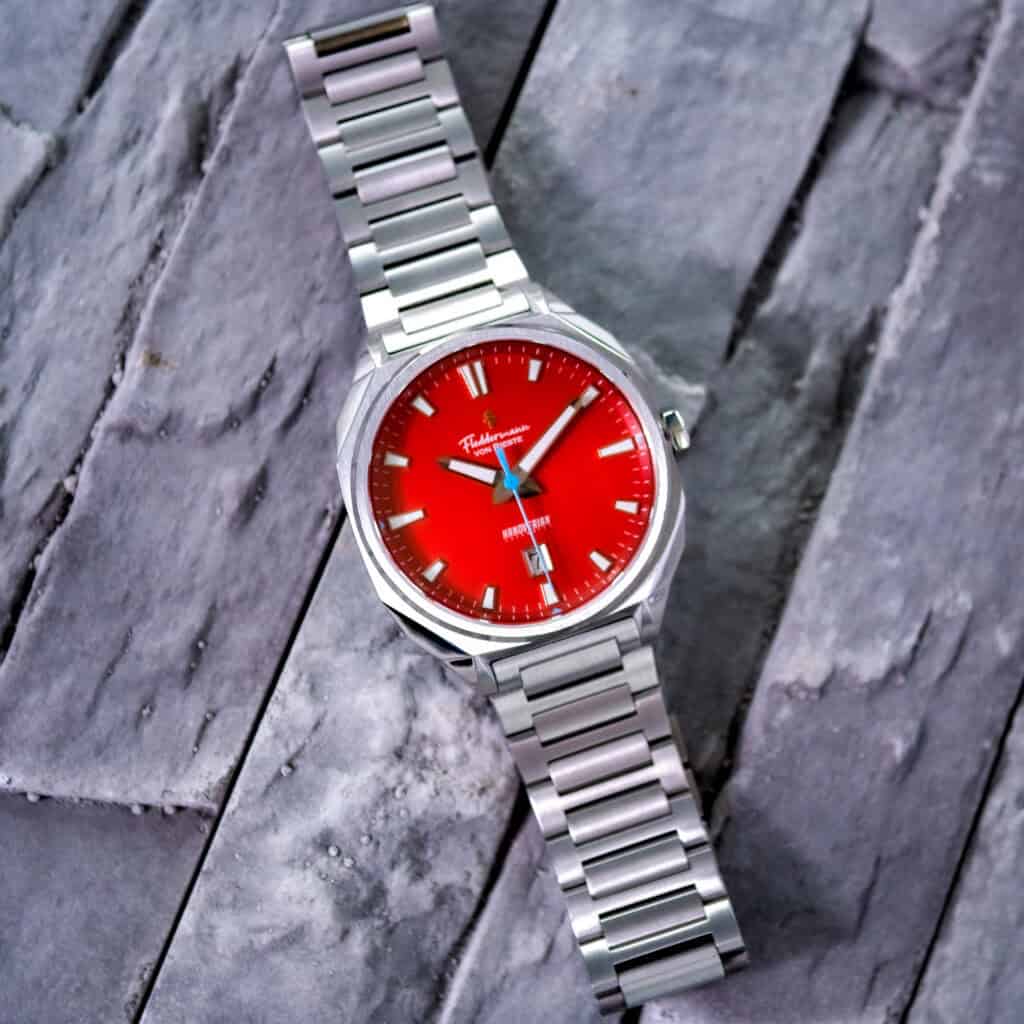
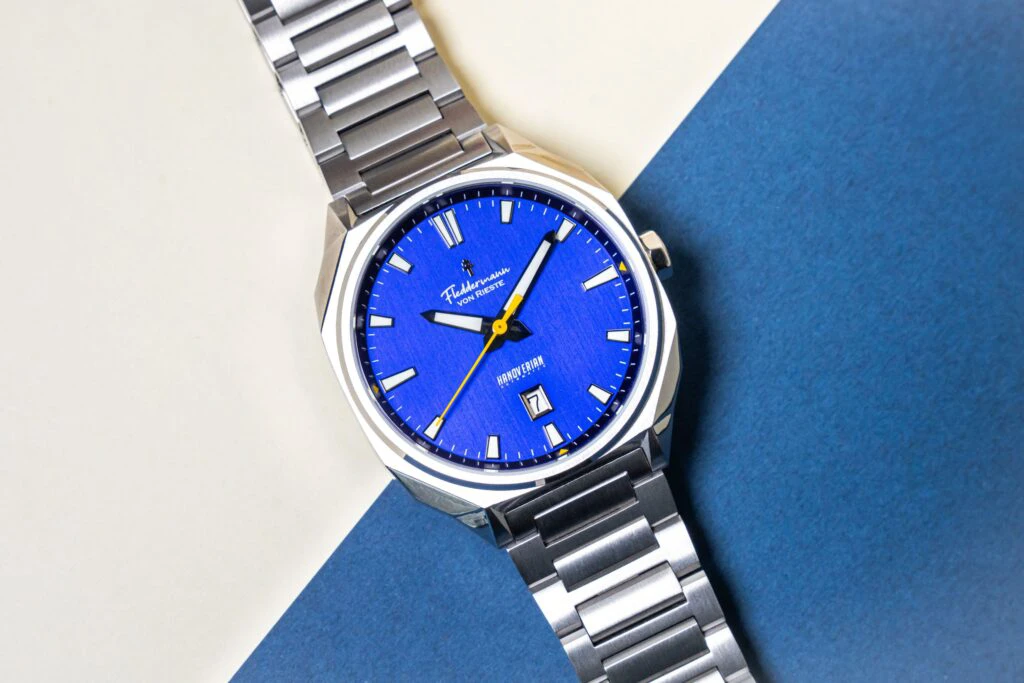
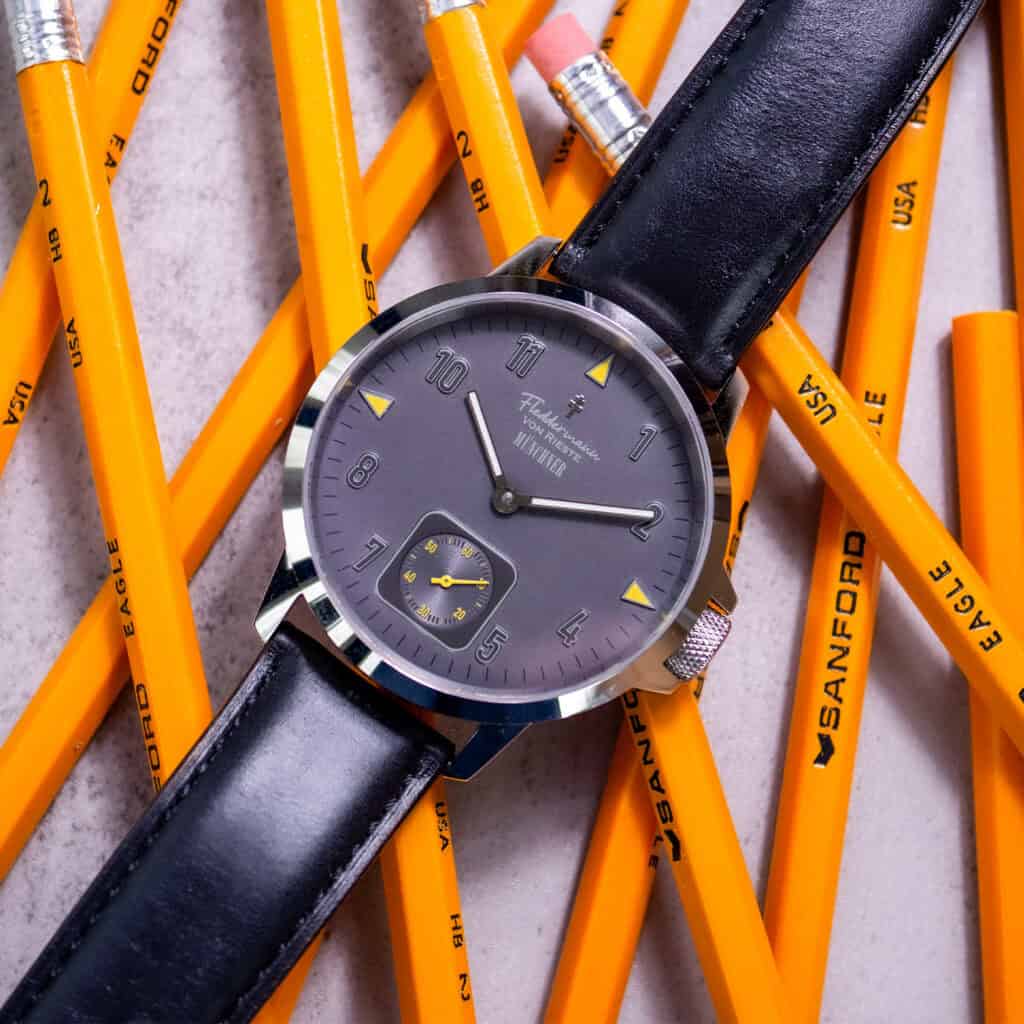
If the hand-wound part of this story is what got you, the Munchner is ours, and you wind it every morning the way Gagarin did. If you’d rather it wind itself, that’s the Hanoverian, our everyday automatic watch. Both are assembled and hand-regulated here in Indiana, and every model but one is an American made watch under $1,000. Neither is going to the moon. They’re just built to still be running when somebody else is telling stories about you.

Dr. Adam Fleddermann, Founder & CEO
Dr. Adam Fleddermann founded Fleddermann von Rieste after growing up watching his father care for a watch passed down through generations of the family. He designs every watch and oversees the brand’s global supply chain, operations, and manufacturing, working alongside an AWCI-certified watchmaker and his team who lead the hand-assembly of every timepiece in Indiana.
